Best AI Exploration and Worlds Game Demos
Explore five AI game demos with diving, survival islands, world travel, reactive music, and playable environments from GPT-5.3-Codex and Claude Opus 5.5.
Which AI Exploration Demo Should You Watch First?
Start with Antikythera Diving Game, a Claude Opus 5.5 demo shared by edwinarbus. The playable screen places a diver at the edge of a shipwreck expedition, presents a clear “Begin the Dive” prompt, and displays movement controls. That simple setup communicates the premise immediately: enter the water, explore the wreck, and control the diver directly.

The shipwreck makes this more than an open stretch of water. It gives the dive a destination and creates a natural reason to explore. The visible prompt also establishes a clean transition from preparation to action, while the movement controls make the game readable before the dive begins. With 73,324 X views, it is the most viewed example in this group and the clearest first stop for someone looking for a playable AI-made exploration scene.
Antikythera Diving Game is especially useful if you want to see how a focused setting can carry an exploration concept. Instead of introducing a large world through explanation, the demo puts one intriguing location in front of the player and invites them to enter it.
Which Demo Turns An Island Into A Survival Game?
Thomas_jorgen shared a multiplayer ARK Survival Island game made with Claude Opus 5.5 and TesanaAI. The demo was created with a few prompts and was played online, making it the clearest example here of an island concept built around multiplayer survival rather than solitary sightseeing.

The interesting part is the combination of setting and social play. A survival island already gives players an understandable reason to move through the environment, while multiplayer adds other people to that space. Exploration can therefore sit alongside the broader survival premise instead of being the only activity.
This is the demo to open after Antikythera if you are interested in a more expansive game idea. Where the diving demo begins with one shipwreck and one explicit starting action, the ARK Survival Island example points toward a shared world in which the island itself supports continued play.
Which Demo Makes World Travel The Main Activity?
The broadest travel premise comes from zudasworld, who shared a game made with help from Claude Opus 5.5. It includes 18 countries that players can explore, along with games to play in those places. Players can drive a taxi around the world, pick up people, or leave the route to explore.

Named destinations such as Niagara Falls and the Louvre make the scale easy to understand. Rather than presenting an unnamed landscape, the demo organizes exploration around recognizable places. The taxi also gives movement a purpose: travel is connected to picking people up, while free exploration remains available when a player wants to look around.
This example is worth seeing for its choice of structure. Eighteen countries provide the larger frame, famous locations provide landmarks, and the taxi provides a recurring activity that can connect them. It is a world-travel game concept in which the journey itself is the central attraction.
Which Island Demo Focuses On Presentation?
Procedural Island Game Concept, shared by Johnlukefrancis, approaches an explorable world through its title screen and campaign map. The colorful presentation includes animated lettering, while a synthesized soundtrack reacts to character movement. Claude Opus 5.5 was used for the demo.

This is interesting because the world is introduced before the player enters it. A campaign map can turn an island into a set of anticipated destinations, while the animated lettering helps establish the game’s identity. The reactive soundtrack connects movement to sound, giving the character’s motion an audible effect within the presentation.
Choose this demo when you want to see how an exploration game can begin building atmosphere at the menu and map level. It is less about a single destination than Antikythera and more concerned with how an island campaign is framed for the player.
Which GPT-5.3-Codex Demo Offers Underwater Exploration?
An Entire Reef to Get Lost In is a playable diving game made with GPT-5.3-Codex. Its world is a reef filled with fish to find, and the player must also watch their oxygen. Those two elements create an immediate rhythm: look for marine life, keep moving through the reef, and remain aware of the resource that limits the dive.
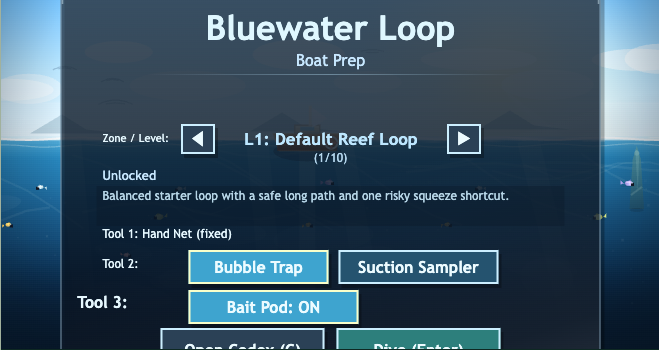
The fish give exploration a concrete target without replacing the pleasure of wandering. Oxygen adds pressure to that search because time underwater matters. Together, they make the reef feel like a place to investigate rather than a background to pass through.
This demo pairs naturally with Antikythera Diving Game because both begin underwater but emphasize different reasons to explore. Antikythera centers the journey on a shipwreck, a starting prompt, and visible controls. The reef demo centers it on discovery and oxygen management. Seeing both makes the contrast between destination-led exploration and ongoing environmental search especially clear.
What Do The Best AI World Demos Have In Common?
These demos make exploration understandable by giving movement a purpose. Antikythera offers a shipwreck to enter. The survival island creates a multiplayer setting for continued play. The world-travel game uses taxi trips, passengers, countries, and landmarks. Procedural Island Game Concept frames its environment through a campaign map, animated title treatment, and movement-responsive music. The reef game asks players to find fish while monitoring oxygen.
For a quick viewing order, begin with Antikythera Diving Game, then move to the multiplayer ARK Survival Island game and the 18-country travel experience. Follow those with Procedural Island Game Concept for its presentation choices, then compare both diving games to see how a wreck and a living reef produce different exploration goals.
The most useful examples here do not rely on scale alone. Each gives the player a readable reason to enter the world, whether that reason is reaching a wreck, surviving with others, carrying passengers, choosing a route across an island, or searching a reef for fish.